Frequently asked questions
Answers to the most important questions about admission, the state FSP, fees, visa and everyday life at the Studienkolleg.
Do I have no, indirect or direct university access?
Whether you need a Studienkolleg depends on the university access your school-leaving certificate gives you in Germany:
- No university access: the certificate does not entitle you to study in Germany – not even via a Studienkolleg.
- Indirect university access: you may study in Germany only after passing the state FSP at a state or state-approved Studienkolleg. This is what the SKHM is for.
- Direct university access: you can study at a German university directly – without a Studienkolleg and without the state FSP.
You can check which case applies to your certificate yourself in the DAAD admission database. For admission to the SKHM, you always prove indirect university access with your school-leaving certificate – and, if you have already studied after school, also with your academic records. The documents listed under Proof of entitlement to attend a Studienkolleg are not proof, but an indication of your university access, and speed up the certificate evaluation in the admission procedure.
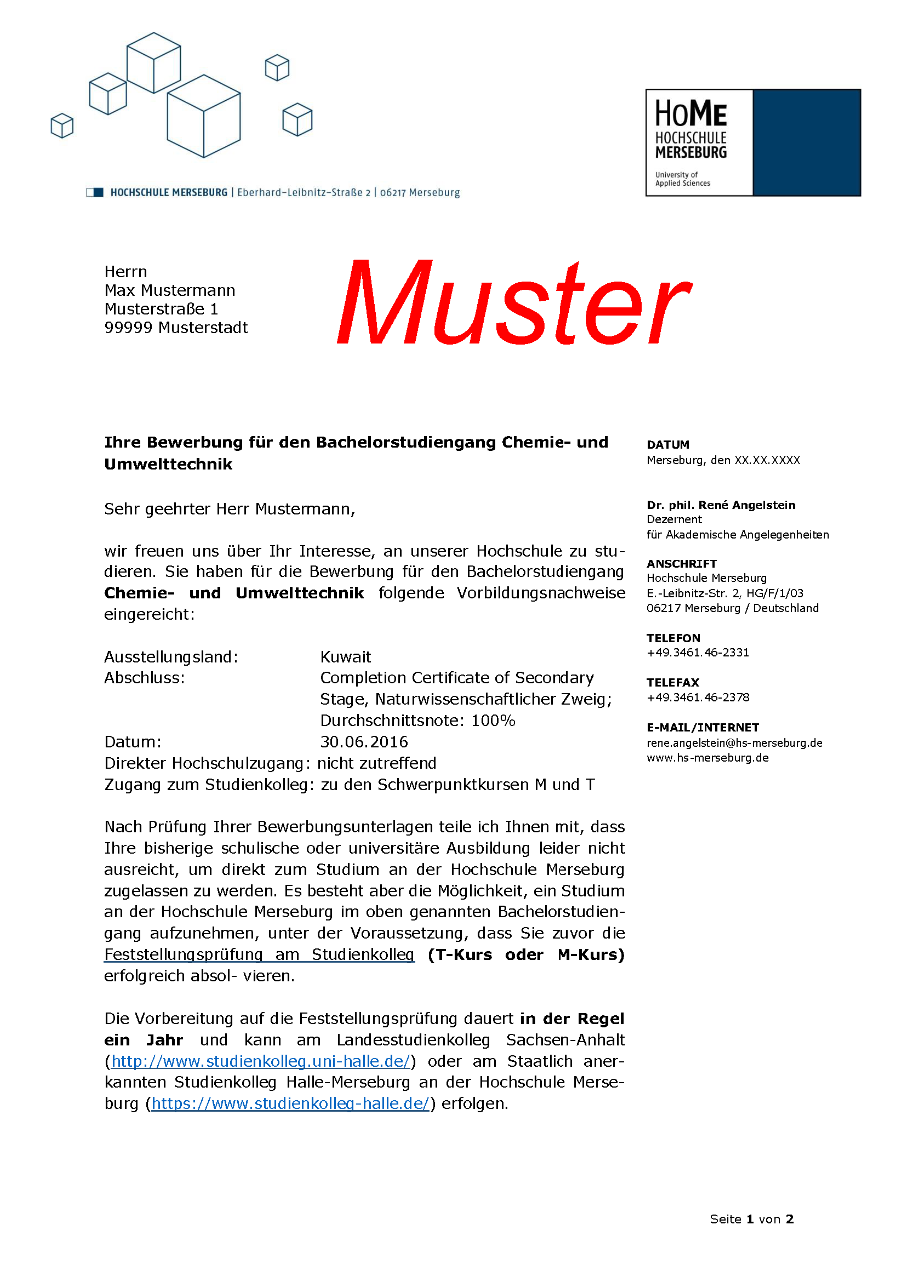
What does a Studienkolleg notice look like? (Example from Saxony-Anhalt)
The following sample shows an example of a Studienkolleg notice from Merseburg University of Applied Sciences: the university states that there is no direct university access and refers the applicant to the Studienkolleg – here with access to the focus courses M and T.
In the German federal state of Saxony-Anhalt, other state universities issue such notices as well, for example Martin Luther University Halle-Wittenberg, Otto von Guericke University Magdeburg, Anhalt University of Applied Sciences, Magdeburg-Stendal University of Applied Sciences and Harz University of Applied Sciences. Layout and wording can differ from university to university – the sample is only an example.
Is the SKHM state FSP certificate recognised by all universities?
Yes. The state FSP certificate of the State-Approved Studienkolleg Halle-Merseburg at Merseburg University of Applied Sciences is a state certificate. It allows you to apply for degree programmes in the field of your focus course at all universities and universities of applied sciences in all 16 German federal states.
Can I study linguistics with the state FSP in the G course? What is the difference between the G, S and S/G courses?
The focus courses G, S and S/G prepare for different, partly overlapping fields of study:
- G course (humanities): entitles you to study the degree programmes assigned to the G course, for example history, philosophy, German studies and literary studies.
- S course (languages): entitles you to study the linguistics and foreign-language programmes assigned to the S course, for example linguistics, English studies and Romance studies.
- S/G course (languages and humanities): combines both focuses and generally entitles you to study the corresponding G and S programmes.
Can I study programmes assigned to the S course with the state FSP in the G course?
Yes, this is possible at many German universities.
Not all state Studienkollegs in Germany offer a separate S course or a corresponding State University Entrance Qualification Examination. Many German universities therefore also accept a passed state FSP in the G course for certain linguistics programmes that are generally assigned to the S course.
Whether a state FSP in the G course is sufficient for such a programme is decided by the respective German university on the basis of its own internal admission regulations.
Important: This restriction only concerns programmes assigned to the S course. For programmes assigned to the G course, a passed state FSP in the G course gives regular subject-restricted university access.
Our recommendation: If, after the G course at the State-Approved Studienkolleg Halle-Merseburg, you would like to take up a programme that is actually assigned to the S course, please ask the admissions office of the university by e-mail before applying. Depending on the university, this is the student registry (Studierendensekretariat) or the International Office.
What is the difference between state, state-approved and private Studienkollegs?
Studienkolleg Fee Entitled to hold the state FSP state none yes – internal state FSP with preliminary grades and external state FSP private with state recognition (e.g. SKHM) yes yes – own state FSP private without state recognition yes no – only preparation for the external state FSP at another Studienkolleg Is the state FSP at the SKHM easier than at a state Studienkolleg?
No. The state FSP at the SKHM is just as demanding as at the state Studienkolleg of Saxony-Anhalt; the state supervises it. “State-approved” simply means that you finance your preparation yourself. Success is ensured not by the fee but by your hard work.
What does the admission procedure involve? Can I be exempted?
For the FSP courses (T, M, W, G), the admission procedure consists of a German test at level B1 (C-test and short written task) and a personal admission interview. You are exempt from the German test if you submit a recognised German certificate at level B1 or higher of the Common European Framework of Reference for Languages (CEFR). Recognised are in particular certificates of the Goethe-Institut, telc and ÖSD, the German Language Certificate (DSD) level I or higher, the DSH level 1 or higher from an examination centre registered with the German Rectors' Conference (HRK), and TestDaF with at least TDN 3 in all four parts. If there are justified doubts about the authenticity of a certificate, the SKHM reserves the right to hold an additional German test. There is no exemption from the admission interview.
The requirements for the preparatory German course (A1–B1) and the German course (B2–C1) are listed under Requirements by course.
Does the SKHM issue invitations to an admission procedure in Germany or conditional admissions?
The State-Approved Studienkolleg Halle-Merseburg at Merseburg University of Applied Sciences (SKHM) does not issue invitations to an admission procedure in Germany that can be used to apply for a visa for Germany.
Conditional admissions are only possible within agreed partner programmes with our partners abroad. They are subject to the successful completion of the admission procedure abroad and to payment of the tuition fees on time.
No conditional admissions are issued to individual applicants from abroad. They receive their binding admission without further conditions only after successfully completing the 7 steps of the application procedure, including receipt of the required payments.
This rule ensures a transparent and reliable admission procedure and, in particular, prevents the misuse of invitation and admission documents in connection with applications for visas and residence permits for Germany.
Are there fees? Can I work alongside the course?
Yes, the SKHM charges fees for the state FSP courses and the examination (see Courses & fees). These fees do not apply if the tuition fees are paid by a state (e.g. as part of a scholarship) or by an employer; we provide the fees for these cases on request. Although residence law allows you to work part-time, it is not realistic to earn the fees and your living costs this way because of the high workload of the course.
How do I progress to the 2nd semester?
The following applies to progression: Progression from the first to the second semester of the programme is refused if
- the semester grade “mangelhaft” (poor, 4.1 to 5.0) was obtained in two subjects,
- the semester grade “ungenügend” (insufficient, 5.1 to 6.0) was obtained in one subject, or
- the semester grade “mangelhaft” (4.1 to 5.0) or “ungenügend” (5.1 to 6.0) was obtained in German.
Can I apply directly for the 2nd semester?
No. Under the current Studienkolleg regulations of the German federal state of Saxony-Anhalt, it is not possible to apply directly for the 2nd semester.
However, at the end of the 1st semester the SKHM may, on request, admit students who meet certain requirements to the Freiversuch (free attempt) of the state FSP (FSP FV), provided capacity is available. There is no legal entitlement to this.
What is a supplementary examination?
If, after passing the state FSP, you want to study a programme for which your school certificate – but not your focus course – qualifies you, you take a supplementary examination in the examination subjects of the corresponding course. Previous results are credited at the discretion of the examination board. A failed supplementary examination can be repeated once.
Do you offer an external state FSP or the DSH examination?
No. The SKHM offers the state FSP only to its internal students. The DSH examination is offered neither internally nor externally.
Can DSH, TestDaF, DSD, telc or Goethe exempt me from the German part of the state FSP?
Yes, with one of the following certificates:
- DSH 2
- TestDaF with TDN 4 in all parts
- Deutsches Sprachdiplom level II (DSD II)
- Goethe certificate C2: Großes Deutsches Sprachdiplom
- certificate of the passed German part of the state FSP
- telc Deutsch C1 Hochschule
Is the German part of the state FSP recognised as proof of German at level C1?
Under § 5 (2) of the Framework Regulations on German Language Examinations for Studies at German Universities (RO-DT), the passed German part of the state FSP counts as proof of the language skills required for all degree programmes.
The German part of the state FSP is an examination certificate in its own right and stands on its own legally.
The Federal Office for Migration and Refugees (BAMF) also recognises the German part of the state FSP as proof of German at level C1 under the conditions it has set. In practice, other federal and state authorities often follow the BAMF's recognition rules.
Important: For taking up university studies, the recognition of the passed German part is already regulated by the RO-DT. For other purposes, in particular towards authorities or other institutions, you need to find out yourself from the responsible office how your German part of the state FSP is recognised or classified. You are of course free to point out to the authority or institution that the BAMF recognises it as proof of German at level C1.
Can I request an additional certificate from the SKHM stating that my passed German part of the state FSP is equivalent to level C1?
No. Even though the Federal Office for Migration and Refugees (BAMF) recognises the German part of the state FSP as proof of German at level C1 under its conditions, the State-Approved Studienkolleg Halle-Merseburg at Merseburg University of Applied Sciences (SKHM) is not authorised to issue separate C1 certificates or certificates of equivalence for it.
Within its state approval, the SKHM has a clearly defined teaching and examination mandate. This comprises in particular the state-regulated courses leading to the state FSP and the State University Entrance Qualification Examination under the applicable regulations of the German federal state of Saxony-Anhalt.
Issuing additional C1 equivalence certificates is generally not part of the state-regulated examination mandate of state and state-approved Studienkollegs in Germany. Such an authority would have to be based on the applicable legal provisions or an explicit authorisation. No such authority is provided for the SKHM within its state examination mandate.
The SKHM can therefore not issue additional certificates on individual request for private, professional or other official purposes that go beyond the examination certificates provided for by law.
Please note: For university studies, the recognition of the passed German part is regulated by the RO-DT. For all other purposes, you are responsible for clarifying the recognition or language-level classification of your German part of the state FSP directly with the responsible authority or institution. The SKHM does not issue additional certificates of equivalence for this.
Can my visa be extended with the SKHM certificate of enrolment?
The SKHM is state-approved; once admitted, you are in a state-approved preparatory course. Under Section 16 (1) of the Residence Act, the extension must be granted provided the other requirements are met – including proof of financial means, health insurance and a tenancy agreement.
Is attendance compulsory?
Yes. Enrolled students must attend all classes and take part in the regular written and oral assessments. This also includes active participation, homework and preparing for lessons.
Are the state FSP courses eligible for BAföG?
The SKHM is listed in the register of training institutions of Saxony-Anhalt; pupil BAföG can be applied for to attend the state FSP courses. Your local BAföG office decides whether you personally are eligible.
How can agencies cooperate with the SKHM?
Agencies and tipsters register as partners in the SKHM Portal. Find out more on the Partners page. Please send cooperation enquiries via the contact form – stating your organisation, your position and your website.
What do abbreviations such as 1FS, sFSP or FSP FV mean?
In SKHM notices, e-mails and lists we use the following abbreviations:
Abbreviation Meaning 1FS 1st semester (1. Fachsemester) 2FS 2nd semester (2. Fachsemester) sFSP written state FSP within an FSP procedure mFSP oral state FSP within an FSP procedure pmFSP mandatory oral state FSP fmFSP voluntary oral state FSP NP resit examination (Nachprüfung) within an FSP procedure FSP FV free attempt (Freiversuch) of the state FSP FSP always stands for the State University Entrance Qualification Examination (Feststellungsprüfung).
Your question is not answered here? Write to us – we will get back to you as soon as possible.